

Water. Earth. Fire. Air.
Avatar: The Last Airbender is a television show that aired on Nickelodeon between February 2005 and July 2008. The engaging storyline and stellar animation ensured that A:TLA quickly built up a dedicated following, and Netflix’s featuring of the show brought it a new wave of attention.
Apart from setting a high standard for children’s television, A:TLA was unique for the heavy Asian influences on its fantasy world; particularly through the cultural uniquities displayed as the characters journey through the four nations.
Part One: Fire Nation
The Fire Nation, in particular, is noted as influenced by East, South, and Southeast Asian culture[1]. In exploring these inspirations, the South Asian influences may be a little more covert than the Eastern or Southeastern homages.
Let us start with the obvious.
Agni
When focusing on South Asian influences on A:TLA, the deity honoured by the Fire Nation is sure to be the first that comes to mind. This is for a couple of reasons – first off, the word “Agni” translates to “fire” in Sanskrit, a language spoken by the Indo-Aryan settlers of north India and Pakistan. Sanskrit is mainly used in present-day Hindu rituals and in the study of ancient Indian literature, and many current-day Indian languages can trace their roots back to Sanskrit[2].
In discussing Hinduism, we arrive at the second layer of cultural influence. Agni is the Hindu god of both fire and lightning; and while it is clear that the Agni from A:TLA is not intended to be a Hindu deity, the firebending and lightningbending characteristic of the Fire Nation pays homage to what Agni represents.

Additionally, during season three’s The Firebending Masters, two members of the main ensemble, Zuko and Aang, journey to find the source of firebending. They encounter the Sun Warriors, an ancient society of master firebenders, and discover that fire is equally life as it is destruction[3]. This dichotomy between the two purposes of firebending – the “good” and the “evil” – is mirrored in modern Hinduism’s perception of Agni. He, too, is composed of “good” and “evil”, and is equally beneficent as he is malevolent.

Subsection: Combustion Man
Speaking of references to Hindu lore, Combustion Man had a very overt reference to the Hindu god Shiva. Firstly, the character design features a tattooed third eye placed vertically in the centre of his forehead, surrounded by a three-fingered mark, which is directly drawn from the same mark that most popular depictions of Shiva portray.

Additionally, much like the name suggests, Combustion Man firebends through explosive blasts from his tattoo[4]. In Hindu mythology, Shiva is associated with Agni through the cycle of destruction, transformation, and rebirth. In folklore, anything exposed to Shiva’s opened third eye is incinerated, similarly to Combustion Man’s particular style of firebending.
Practices
The culture of the Fire Nation, as portrayed within the show, also has a few major South Asian influences.
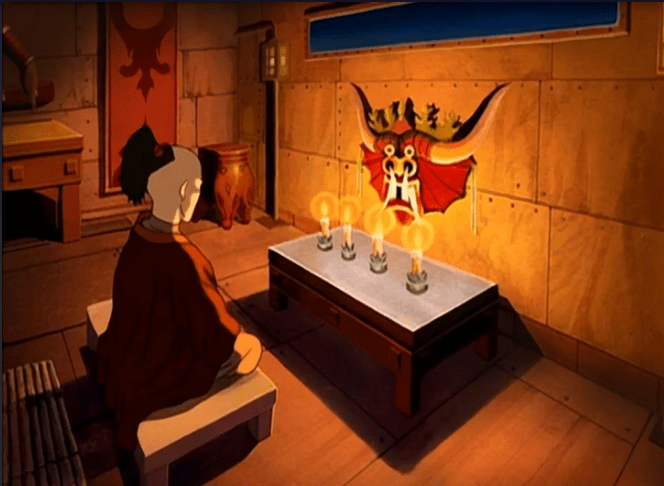
The first has to do with firebending, the Fire Nation’s main martial art. While the firebending fighting style is based mostly on the Northern Shaolin style[1], there is one notable element of the bending style that is reminiscent of Kalaripayattu, a South Indian martial art – mainly, the aspects of breath and balance. One of the main facets of Kalaripayattu is meditation and breath[5], which is very reminiscent of firebending; it is mentioned multiple times throughout A:TLA that breath is central to the art, and the firebenders in the cast often are shown meditating with candles. Similarly, in season two’s Bitter Work, Zuko’s Uncle Iroh tells him that lightningbending requires perfect internal balance[6], which is one of the goals that disciples of the Kalaripayattu style attempt to reach[5].
The second has to do with death rites. In season two’s Zuko Alone, Zuko recounts the events following his grandfather’s death[7]. During this, the viewers experience his grandfather’s funeral, wherein he is cremated on a pyre. Cremation plays well into the Fire Nation’s characterisation, and additionally is a common Hindu practice.

And finally, we come to the inspiration for this post’s title:
Subsection: Agni Kai
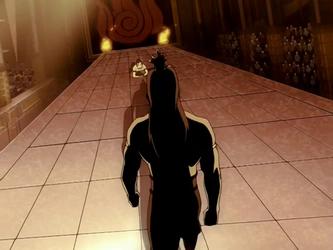
According to A:TLA lore, an Agni Kai is a firebending honour duel, wherein two firebenders fight in a demarcated arena to the first burn. In the show, three notable Agni Kais occur – the first, between Zuko and his father, Firelord Ozai, the second, between Zuko and General Zhao, and the third, between Zuko and his sister, Princess Azula. The honour duel system is reminiscent of many different traditions of ancient South Asian cultures[1], but details shown in the Agni Kai scenes narrow down the inspiration to the duels often fought in South Indian warrior societies.
In the one official Agni Kai that takes place during the show, the duel is fought in a specific arena, composed of a raised platform and a large audience section, since Agni Kais are meant to be public. This mirrors the preparation for the Kalaripayattu duels of ancient India; since duels were meant to be a test of honour, the entire society was invited to spectate, and the duels themselves took place on a raised platform[8], similar to the Agni Kai grounds.

The reasoning behind fighting an honour duel[8] is also portrayed similarly; Kalaripayattu duels were fought to decide disputes between rights to the throne, like the duel between Zuko and Azula, as revenge for an insult or wrongdoing, like the duel between Zuko and Ozai, or other personal settlements, like the duel between Zuko and Zhao.
Part Two: Air Nomads
The Air Nomads are a migratory, free-spirited culture that are inspired heavily by the cultures in and around the Himalayas[1], from the buddhist-inspired lifestyle and philosophy to the mountainside temples and cliffside architecture. Buddhism, which originated in modern-day Nepal, is a strong influence on the Air Nomads; and the various schools of Buddhism – particularly the Tibetan offshoot of Vajrayana Buddhism – are present in Aang’s views and traditions.
Values
One of Aang’s closest-held traditions is the tradition of nonviolence – throughout much of the show, he struggles between the necessary self-defence to survive and his master’s teachings, which centre around peaceful conflict resolution and respect for all living things. In fact, the friction between his responsibility to end the war – which, for the majority of the show, is taken to mean “kill Firelord Ozai” – and his wish to stay true to his belief that all life is sacred is a major element of the series finale, as the final battle looms and Aang must decide what to do.

This idea of the sanctity of life and the importance of nonviolence is derived from the concept of ahimsa, which states that all life is one, and therefore sacred, and that nonviolence should be a core principle of one’s lifestyle[9]. Ahimsa originated in ancient Indian society, and is a key component of many of the region’s religions, like Hinduism, Buddhism, and Jainism.
Another part of Air Nomad culture that is referenced heavily in A:TLA is the tradition of vegetarianism. This ties into the principle of ahimsa, in that living organisms are not to be killed; but interestingly, Tibetan Buddhist monks are not vegetarian. Instead, vegetarianism is a trademark of the Mahayana school, which is mostly present on the Indian subcontinent, as well as Hinduism.
Spiritual Tradition
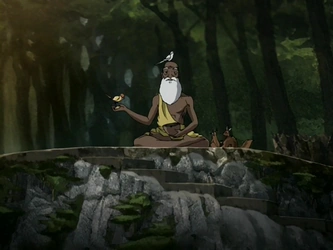
In season two’s The Guru, Aang learns from Guru Pathik, a spiritual brother of the Air Nomads and a friend of Aang’s teacher. Apart from the obvious – the guru’s South Asian features, “Pathik” meaning “traveller” in Hindi, and “Guru” meaning “teacher” in Sanskrit – the guidance he gives Aang is heavily influenced by Hindu principles.
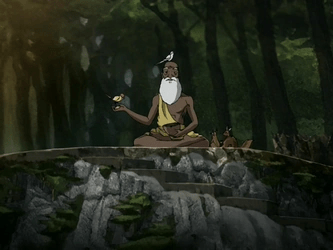
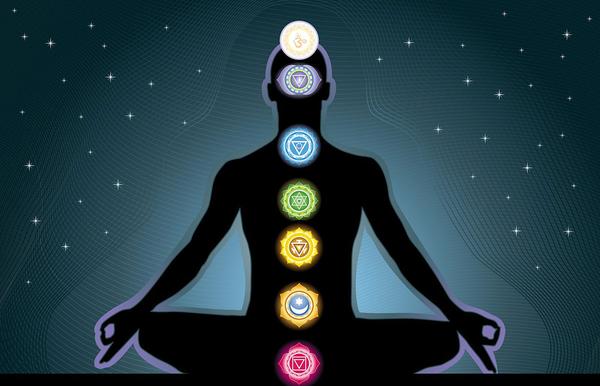
The main task that Aang attempts during his training is the clearing of the seven chakras, which are each explained to symbolise energy centres that affect mental, spiritual, and physical well-being. The chakras themselves, their placement, and their meaning are all drawn from Hinduism; and “clearing them” is supposed to improve well-being and control over oneself, similar to Aang’s wish to gain control over his internal spirit, the Avatar state.
Subsection: Depiction
In one scene, Guru Pathik is depicted with six arms, strumming a veena. This mirrors the image of Saraswati, the Hindu goddess of knowledge, which creates a parallel between the role Guru Pathik takes in the show and Saraswati’s role in the Hindu pantheon.
Additionally, Guru Pathik’s clothing is reminiscent of the way ancient Indian ascetics are depicted in old artwork, and Aang’s traditionally orange robes are reminiscent of Shaolin monks, who were inspired by visiting Indian Buddhists[1].
Part Three: Other
The majority of South Asian influences on the show are confined to the Fire Nation and the Air Nomads, but a couple more instances of inspiration appear in the Earth Kingdom and the Water Tribes, notably, in architecture.
In season two’s The Library, the main ensemble hear about a spirit library rumoured to exist in the Earth Kingdom’s Si Wong desert from an archeologist. When pressed for details, he reveals an illustration of the aforementioned library. The domes and spires of the library closely resemble the architecture of the Mughal Empire, which spanned across Pakistan, Bangladesh, and much of North India. The layout of the library mirrors the Taj Mahal in particular[10], which is one of the most famous Mughal monuments.

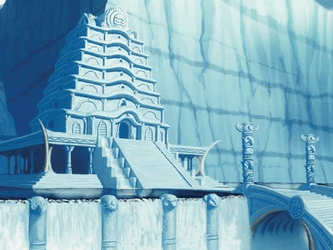
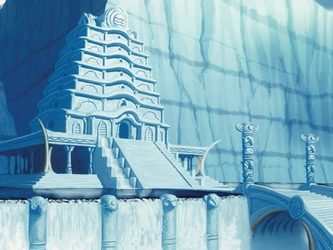
Additionally, in season one’s The Waterbending Master, the main ensemble arrives at the Northern Water Tribe, and glimpse the chief’s palace. With its stacked structure and intricate carvings, the palace is reminiscent of Dravidian-style Gopuram temples[10], which are found in South India.
Overall, Avatar: The Last Airbender is rich with cultural influences from across the Asian continent, each interplaying off the surrounding traditions in a manner very reminiscent of the cultural interactions of ancient Asia. Just as real Asian cultures borrowed elements from each other while remaining distinct, each influence in A:TLA is wonderfully unique while still retaining cultural individuality. The inclusion of important south-Asian influences in the show both lends complexity to A:TLA’s ancient Asiatic world while also recognising the dimension and diversity of Asia as a continent, in a time when Asia was widely viewed through a unidimensional western lens.
Furthermore, A:TLA provided one of the first genuine depictions of South Asia in western media – a genre saturated with over-the-top accents, mockeries of tradition, and flat, stereotypical characters, setting a much-needed standard on South Asian representation, and introducing the idea of a complex, diverse South Asia to the global viewer.
 Generasian
great article! i hear a lot about east asian influence, it’s nice to hear about south asian as well 🙂
LikeLike
Ik that this was written before natla, but maybe it would be interesting to explore that in the future? Good work tho, well written.
LikeLike
this is a really amazing article, so well written!! wonderful job to the writer 🙂
LikeLike