
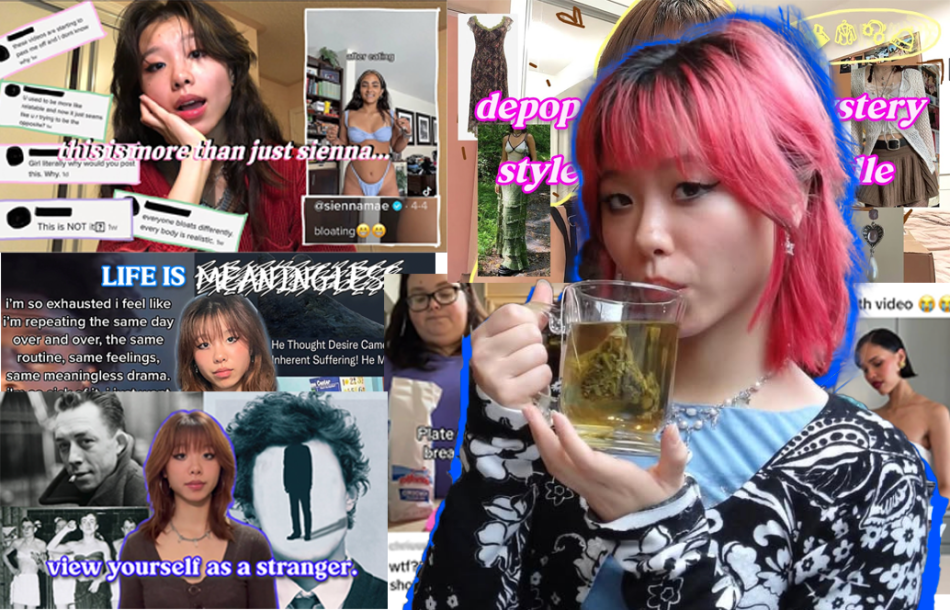
Chinese-Canadian content creator and philosopher Olivia Sun, 22, better known under her channel name oliSUNvia, uses her channel to teach. “Fruity haired philosophy girl,” as she jokingly introduced herself as in a video, or “the most annoying and boring YouTube video essayist”, Olivia runs a YouTube channel that has over 1.16 million subscribers. You might’ve seen her videos pop up in your recommended feed on YouTube, or even heard her being recommended by other creators in the niche “video essay” circle. On her channel, she makes researched-backed videos that receive millions of views about all sorts of topics: mainly philosophy, social issues, feminism, Asian American culture, and fashion. In her educational career, she is currently pursuing a master’s degree in philosophy and plans to pursue a joint JD and PhD.
When Olivia first began her channel, she didn’t dream it would be as big as it is now. Olivia began her channel in 2021, during Covid. When nobody could leave their houses and had to figure out a new hobby to pass the time, Olivia became inspired by philosophy YouTubers like Contrapoints and Philosophy Tube, and found her passion in YouTube. “I wanted to do something productive with my time, especially as an Asian Canadian with immigrant parents, you are raised to be a tryhard when it comes to academics,” she told me. “As I was online like everyone else, I became aware of video essays, or commentary channels, and I saw them as a way to express your opinions, put them in a way other people could understand, be receptive to, and I thought okay, this seems like a way to still be academically productive during these times, so I started making my videos.” When Olivia began making videos, she didn’t really know what made her so popular. According to Olivia, her first video took an hour and a half to write the script and zero research. Months after she would release her videos, they would suddenly start gaining popularity, and her channel’s subscribers began to accelerate. By December, only months after she started posting content on her channel, Olivia already had 72,000 subscribers.

As a Chinese-Canadian, Olivia grew up in a largely Chinese community in Ontario. When she was 11, she moved to Oakville, a largely white community. “I definitely had a hard time adjusting to that and I think it dented my sense of self worth for a while because I went from seeing everything, everyone that looked like me to going into a place where everyone was not like me,” Olivia said. She continues, relating her racial identity to W. E. B. Du Bois’s idea of double consciousness.
“There’s this concept called double consciousness from this thinker called Du Bois. And for him, he’s talking about like Black Americans, but I think it applies to really any racial minority living in Canada or America or somewhere else that they don’t belong. And it’s like, you have this double consciousness where one side of you is super aware of, let’s say like my Canadian side, and the other one is super aware of my Chinese side and then you’ll experience conflicts between the two and you feel like you don’t fully belong in either. So, growing up, my mother language was Mandarin and now it’s really bad. Like I can’t speak it super well. I can still understand it, but it’s been lost a lot because when I was younger, very quickly I got put into English speaking daycare and school.”
Over time, Olivia began to recognize that her identity was not something to be ashamed of. She began to embrace that idea as she learned more in her education. “Learning about the history of how Asian people immigrated to places like Canada and America,” she answered when asked about what caused her to begin to find pride in her identity. “The discrimination that occurred against them, the ways that they succeeded in these places nonetheless, and how so much of our countries are built on the backs of like immigrant labor, immigrant culture. That made me really start to be proud of people from my culture flourishing here.”
Olivia’s advice for young people who are facing similar identity problems? Embrace and be proud of your heritage. “I don’t need to change myself either because I’m sure people appreciate and know me for the way I currently am. And there’s something that’s beautiful about every person looking unique. And I know that sounds really corny, but sometimes cliches are true,” Olivia said. Her other advice is to not look at Western or Asian beauty standards. Both are extremely unhealthy, and oftentimes unattainable; East Asian beauty standards often require strict dieting or plastic surgery to attain, something that is not ideal in Olivia’s opinion. Rather than try and preserve your outer image, she wants people to instead cherish the relationships with people who will love you no matter what you look like, and focus on your spiritual happiness.
Oftentimes, philosophy can feel inaccessible to most people; there is a high barrier of entry for philosophy, and reading philosophy texts can be difficult for those outside the field to understand. Olivia’s goal with her channel is to make philosophy easier to access and understand.
“I feel like there is something I’m doing in making education more accessible to people because academia is pretty exclusive and a lot of people face barriers to accessing it, especially when it comes to what I study being philosophy. A lot of the time, it’s like an ivory tower subject.”
Despite these challenges, her YouTube channel remains dedicated to making these “ivory tower subjects” more accessible to wider audiences through the use of short form video essays.
For example, in one video, titled “how would YOU solve a moral dilemma”, Olivia teaches her audience the concept of meta-ethics. She begins by looking at The Baby Problem. The Baby Problem’s scenario goes as follows: a serial killer is in the house, and you and your family are hiding in the closet with a baby. If the baby cries, or screams, or makes any noise, the serial killer will find and kill your entire family. The question proposed is, do you kill the baby? Instead of going through and definitively answering the question, Olivia uses this as a transition to talk about meta-ethics. To answer the scenario would be using applied ethics, in which one uses ethical theories to decide how to act. Meta ethics is the branch of ethics that explores the nature of morality. It studies questions like where do our ideas of good and bad come from? Can we measure how good or bad something is?

In her other videos, she does philosophical analyses of modern day problems, such as in her video, “drowning in entertainment: the age of distraction”, where she claims that society’s shift to social media as the primary form of communication has led to a decline in critical thinking and attention spans. In her video, she introduces the audience to the work of Neil Postman, a staunch critic of the overuse of technology in society, through his book “Amusing Ourselves to Death”. As entertainment has become the primary form of experiences, humans have begun to lose what it means to be well informed. In the video, Olivia also analyzes her own role as a video-essayist in this crisis. “As a video essayist who tries to make educational content in a more entertaining manner, I’ve wondered a lot about how I fit into all of this,” she says. “Will the visual form of video essays inherently make my image more representative of me than my words and ideas?” She comes to the conclusion her videos are more “entertaining”, they inadvertently make her ideas more trustworthy to us.
One of the major problems Olivia faces in making her videos is balancing the goal of accessibility with discussing more nuanced philosophical topics. During our conversation, she told me about two main topics she would like to discuss that she thinks her normal YouTube audience just wouldn’t understand. The first topic was, as she titled it, “moving past contributory injustice using moral imagination, and how this can resolve attention in feminist standpoint epistemology”, which, explained by Olivia, is essentially, “people occupy different social positions based on their position of power in society and also their identity. And so as a result of that, they’ll know different things about the world.” This raises questions about how to retain a sense of “objectivity” or “shared” knowledge and how to communicate knowledge across radically different positions. Olivia thinks a certain type of imagination can be a potential tool to navigating these questions – one that sees an accurate imagining of others as inseparable from a moral engagement with others. The second topic she wished she could talk about was whether vigilantism could ever be considered civil disobedience, and not just uncivil disobedience. As a content creator, Olivia believes that it isn’t possible for her to talk about this with her normal YouTube audience because the pre-existing framework needed to understand these ideas are just too much. In “how would YOU solve a moral dilemma?”, Olivia felt like she was taking a risk because it was so theory heavy, and thus wouldn’t be understood by a lot of her audience. “I was really nervous about putting out that video because I thought it would not do well because it didn’t have, I don’t know, like mainstream trends or mainstream references to keep people’s attention being engaged,” she said. The fact that the video did well showed that audiences weren’t just interested in “pop philosophy”, but they were also interested in the deeper topics that Olivia was learning about in her educational career.
As a content creator, Olivia believes that she has certain responsibilities in using her voice for social activism. When asked whether or not she believed that content creators had a responsibility to voice their opinions online, she said that she believed that content creators who weren’t super educated on the topic, like Trisha Paytas for example, did not have a responsibility to voice their opinions. But, if it’s appropriate, some content creators do have an obligation to voice their opinions. “If you’re a content creator who does create like certain political or social content, or if you’re a content creator with a huge following. That’s another exception to me. Then I do believe they have a responsibility to voice their opinion.” Olivia has consistently worked to raise money for humanitarian causes, recently participating in a fundraiser for Lebanon, Palestine, and Syria. Olivia believes that content creators have a greater responsibility to voice their opinions than celebrities because celebrities often voice the talking points of the corporations that back them.
“Content creators have a greater responsibility, because they are talking often directly with people. And so their opinions are always sort of belonging to themselves.”
The video essay format that Olivia uses also has its own challenges. As her channel has grown, Olivia has understood that as a female content creator in a male dominated space, appearance plays a much larger role in her credibility than for other content creators. Olivia describes one comment that the controversial content creator Sneako, known for his homophobic and misogynistic views, made to his audience of thousands.
“He made a livestream once, and he was reacting to one of my videos, and he was like, as soon as I came on camera, he paused the video and he was like, ‘Oh, you just know this girl sat there for 40 minutes, adjusting her lighting, touching up her makeup to make sure that she looks cute in front of the camera. That’s all women know how to do, you know, looking cute.’”
Another content creator reacted to one of her videos, and told his viewers to rate her attractiveness. Comments like those are challenges that male content creators don’t face. As a result, Olivia tries to challenge the stereotypes she faces through the way she presents herself in her videos.
“I definitely feel pressure sometimes to present more masculine, because that might get me to be taken more seriously. But I think because of that, I have intentionally tried to continue presenting feminine. Like, I’m going to wear my eyeliner and lipstick in my videos, and I’m going to wear fun, colorful jewelry because those shouldn’t be indicators of how smart someone is. And I’m hoping that I can challenge that, but I’m not sure how well I’m doing it.”
Yet in her resistance to the male gaze dominated space that she creates content for, she believes that she has found a bit of a niche that has boosted her popularity.
“It’s worked well for me because I think people look at the thumbnail and they go, oh, like girl wearing lots of makeup and colorful clothing talking about Nietzsche? Wait a second, I’m intrigued, I’m gonna click on it. So it’s actually helped boost my engagement in that way, but we’ll have more people questioning whether I said something was right or wrong, versus a male content creator.”
That part of her online persona, the “fruity haired”, colorful philosopher persona, is a niche that helps her stand out from other creators. In fact, for people who want to get into content creation, Olivia advises people to do the same.
“One thing that me and a lot of creators seem to think is to try to find your niche, and it’s not like you have to be super unique from anyone else, but maybe finding a way in which you aren’t just copying what other people are doing. So for example, when I went into video essays, I was like okay, there are a lot of video essays about pop culture which are awesome, but I don’t see many people talking about philosophy so I’m going to try to do that.”
But while finding your niche is important, it’s also important to do what you want to do.
“A key piece of advice is to not cater to trends or mainstream interests too much. And to make sure you have a good balance between that and your own interests and your own projects.”
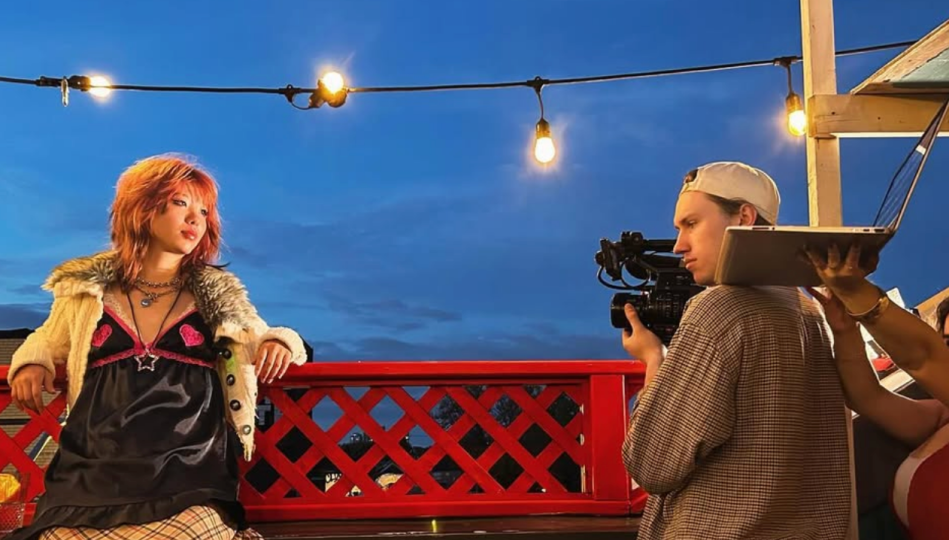
Olivia has just published a mini-documentary about street art and graffiti in Toronto. She plans to pursue a joint JD PhD program and will continue to make YouTube videos as a side-job as long as she can. Check out her YouTube channel at oliSUNvia.
 Generasian
0 comments on “People Don’t Care About Philosophy: Olivia Sun Wants To Change That”