
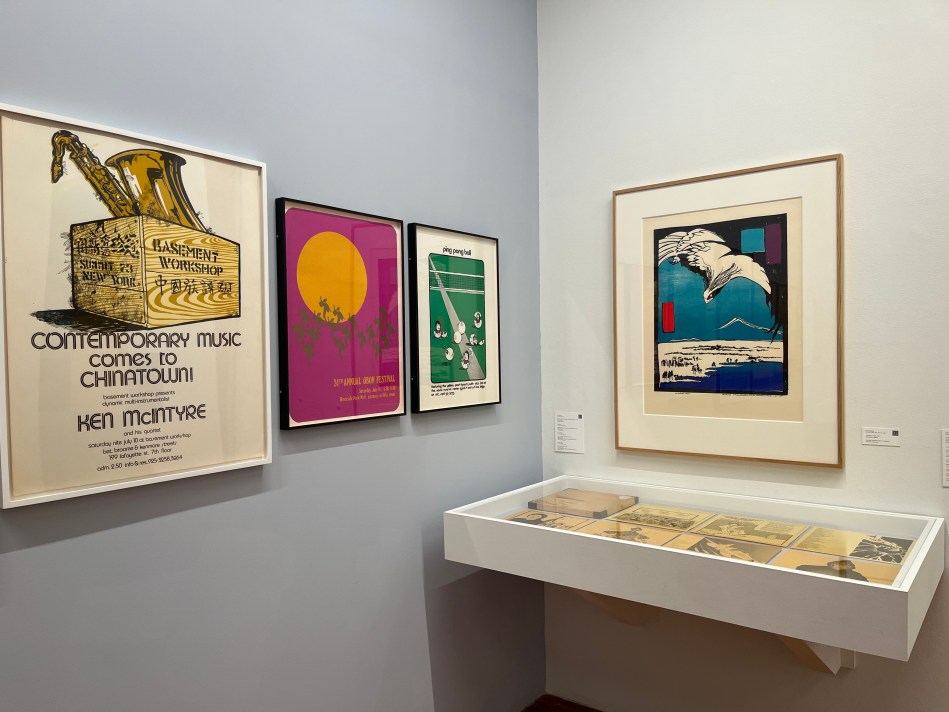
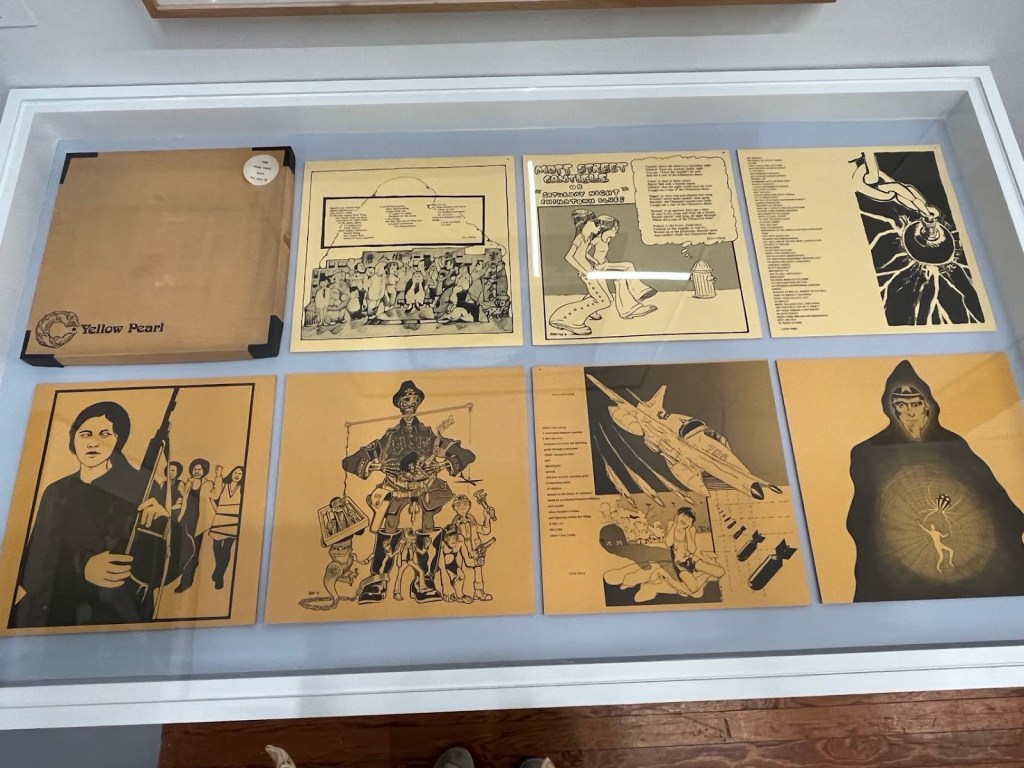
Walking into the first room of Legacies: Asian American Art Movements in New York City, you are first greeted by David Diao’s large-scale geometric abstract painting Odd Man Out as well as one of Isamu Noguchi’s famous Akari lamps hanging from the ceiling. But as you look to the right, lining the wall are 8 bold framed prints; some posters for community events, some printed pieces of writing. On the walls flanking the display are two glass boxes filled with other printed ephemera, a collection of poetry and illustrations. This room is representative of the earliest era of this collection, focusing on the 60s and 70s, around the time the term “Asian American” was first coined in 1968.
I was particularly drawn to the print works, in part because of my own inclination to printmaking and in part due to the accessible nature of printed works. It’s through the accessibility of the printed works that promotes not only community but inspires activism on behalf and within these communities. It was inspiring to see the work of Chinatown-based Basement Workshop, “the foremost pan-Asian political and arts organization operating on the East Coast of the United States”. I often think of Chinatown as the ultimate show of community within the city; a common language of Cantonese and unique architecured alleyways filled with butchershop and hole-in-the-wall restaurants separating this area of downtown from the rest of Manhattan. From the start, the artwork was entangled with politics at the Basement Workshop. Basement Workshop would hold workshops to create posters to “bring to protests and marches around the city”. One of the displays was pages pulled from an anthology produced by the Basement Workshop, Yellow Pearl. The artworks and writing in The Yellow Pearl speak to a larger Asian American experience through the telling of individual experiences, like Fay Chiang’s eggrolls and wonton soup, that puts stereotypical Asian characters and foods beside the lived experience of the working-class Asian American family to call for change.
Printmaking has long been linked to social movements, to the point where methods of printmaking (like intaglio, wood block, screenprinting, etc.) can be associated with political issues at the time of their development. Focusing on screenprint, which rose to popularity with the pop-art movement in the 60s (like the works in the first room of Legacies), we connect the printmaking processes with the need to communicate through writing and visuality about “Martin Luther King in the US, the USSR invasion of Chechoslovakia and Prague Spring, the Educated Youth proclamation of Mao Zedong…and many other events related to the Cold War and its proxy warfare.” In 1965, the Chicano revolution (which very much inspired the Basement Workshop) produced graphic artworks that represented a new cultural context within chicanx artists. Examining the print posters and screen-printed works in the exhibition, I am compelled by Mei-Mei Berssenbrugge’s Chronicle, a piece that combines both the power of print and writing to champion the Chinese language and being raised by grandparents.
The aesthetics and forms of art, advertisement, and writing were all blended in the production of these printed works. Not exactly conceived to be art when they were made, the posters still took influences from pop art, namely in their vibrant colors and blending of high and low culture. In Basement Workshop’s later years, the art aspect influenced the posters more, printing shifting from a political medium to more of a general visual medium. On the other hand, several prints displayed were not explicitly political in nature, but rather advertisements of community projects and events, the medium of print allows for advocacy through awareness and specificity. To me, proving that Asian Americans were actively participating in culture through music, sports, and writing is a way to call attention to the space they occupy, and to say “I am here, and like you I am cultured, I have passions”.
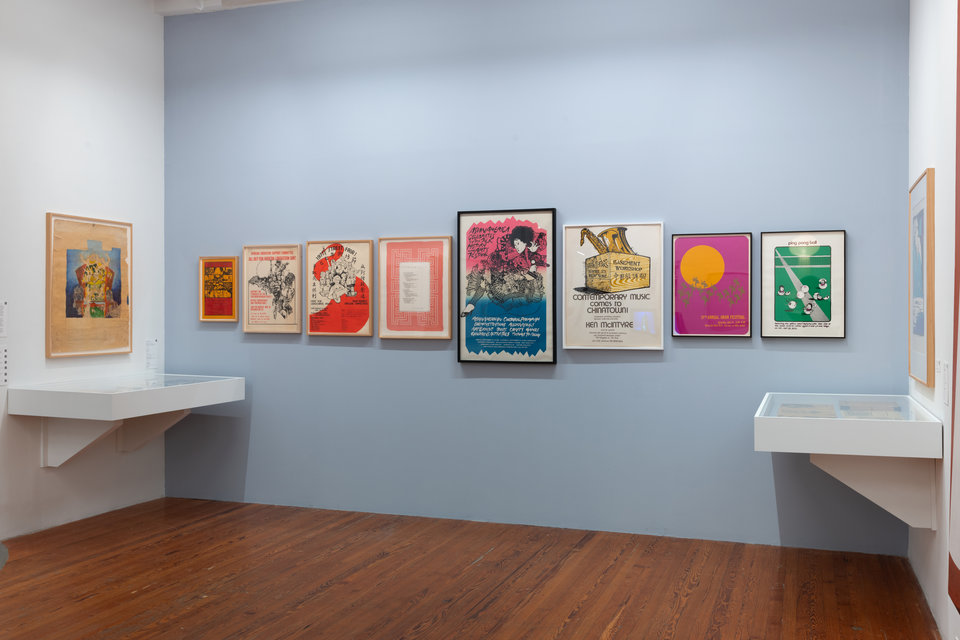
It was especially eye-opening to see a poster created in solidarity with the African community for African Liberation Day, representative of the relationship between political movements during the 60s and 70s. The Civil Rights Movement of the 1960s hailed by black activists was a large inspiration for Asian American revolutionary organizations, especially the Red Guard Party, who were mentored by the Black Panthers. The phrase “Yellow Peril Supports Black Power” was first seen in 1969 on a sign held by Richard Aoki, the only Asian American to hold a leadership role in the Black Panthers, and has since been brought back in 2020 during the Black Lives Matter protest to represent Asian and Black American solidarity. This view into the Asian American past flips contemporary notions of Asian Americans being the “model minority”, a myth that has pitted minorities within America against each other for the benefit of the majority in power.
Beyond the medium of large-scale prints and posters, Legacies also presented various brochures, magazines, zines, and printed matter. Included were issues of “Bridge” an Asian American magazine that subverted the idea of the majority white viewer; this magazine spoke to Asian Americans around the country and discussed “cultural criticism, poetry, fiction, and national political issues of concern”. The exclusion of the hegemonic Western reader and speaking directly to an Asian American audience is a political statement in itself, interrupting the assumptions of white-first narratives.
Personally, the show has felt like it hit me over the head with how specific it was to my own identity – as a Chinese American artist who grew up in New York, spent her formative years roaming Chinatown, and is exploring the medium of print- I couldn’t help but feel like the show was a representation of a cycle and larger narrative I didn’t know I was a part of. It was really inspiring but in a way comforting seeing Asian artists of the 70s through to the 00s exploring themes of self-identity, generational trauma, community, but also just expressing themselves creatively. Perhaps we can learn a lot from the revolutionary lifestyle of Asian Americans in the 1960s. Print is a powerful medium that I feel has been fading in our digital age, but projects like Prints for Palestine have changed how print is used to support a cause (now to raise money as well as awareness) while carrying the rich history of print and political action.
As curator Howie Chen notes, the exhibition only showcases work until 2001, when globalization made the specific identification of “Asian American” less relevant when it came to representation in art. With the inclusion of Asian artists in biennials and larger institutions, the need to differentiate Asian American artists from national Asian artists was deemed obsolete. The label of Asian American was in part one of unity, where a pan-Asian community came to respond to the age-old depiction of “Orientals”. To recontextualize the generalization of the otherized Asian, the pan-Asian movement redefined what it meant to be “Asian American”. But at the same time, the creation of this generalized term erases the nuance in the individual experiences of the specific ethnicities within the larger Asian American label. The Asian American is not a monolith, but a culmination of unique experiences, and we should hold space for those individual experiences. As for the use of print in the discussion of showcasing a more nuanced “Asian American”, print blends the power of visual and textual storytelling while being able to be mass-produced. The print works confront today’s viewers with the same message they did in the 60s and remind us of a greater tradition of activism through artwork. I hope to see more print works that continue to find pride in the Asian American identity and uplift and shine a light on often forgotten communities within the label.
Legacies: Asian American Art Movements in New York City (1969-2001) closes on December 20th, 2024
Featured Image: Cynthia Li
 Generasian
0 comments on “Legacies at 80WSE: Asian American Artists and a History of Printmaking as Activism”