
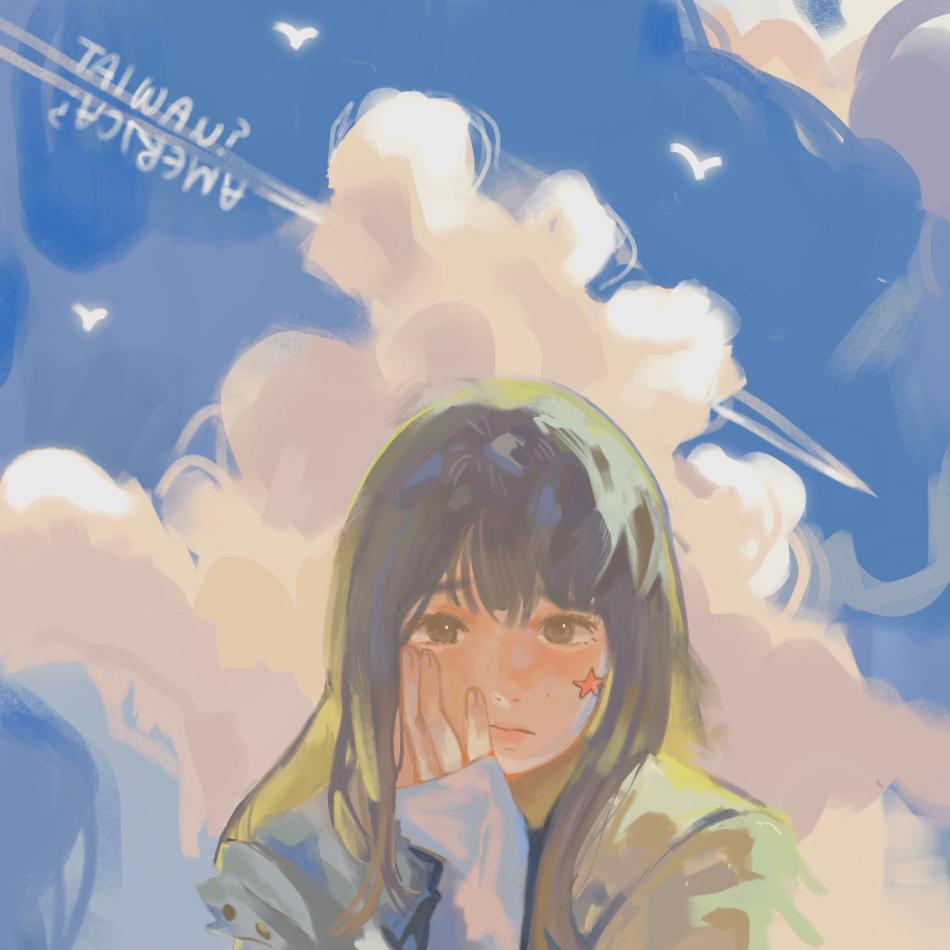
Artwork by Ann Lee
By Helen Kao
Main Street Cupertino, April 2023:
I drove through Cupertino, listening to the Billboard Hot 100’s No. 1 track: “Kill Bill” by SZA. I was on my way to have dessert with my friends at Main Street Cupertino, also known as ABC (American-Born Chinese) Central because it’s home to much of the city’s Asian cuisine: MeetFresh, HaiDiLao, Ippudo, Somi Somi, Koi Palace, 85℃—I could go on. Tonight, we were feasting upon MeetFresh’s Icy Grass Jelly Combo A. Although the menu read primarily in traditional Chinese characters with small English subtitles, we ordered in perfect English because none of us remembered much of what we were taught on those grueling Chinese school Saturdays.
After we finished ordering, I stood waiting for our number to be called, scanning the TV menu to pass the time. This particular dessert shop, being Taiwanese, held a special significance for me. As the only Taiwanese member of my Chinese and white friend group, and among most of my peers in school, I felt a responsibility to claim this brown-sugar syrupy environment with familiarity and pride. Instead, any sense of pride I had was washed away by a flood of guilt when I saw the sea of unfamiliar Chinese characters floating on the TV menu. I was suddenly reminded of a conversation I had with one of the girls in this group two years prior:
“Why are you taking AP Spanish instead of AP Chinese? Aren’t you Taiwanese?” she asked with a tone of false concern. “I’m taking AP Chinese this year because I already learned everything in Chinese school, so it’s super easy.” I knew she was attempting to hide her judgment.
“I only went to Chinese school for a couple of months so I can’t read or write Chinese very well, and it feels kind of late to start now, I guess,” I admitted, hesitating because her question had never occurred to me before.
That was the first time I gave my struggles with my Asian identity any consideration—I had always thought that Chinese literacy was generally a complicated skill that took years to develop, so I didn’t think to feel insecure about it. It was a passing thought then. Now, my Asian identity started feeling like a costume: I was too American to know anything about the origin of the dessert we were about to eat or its name in my native language; I didn’t even know how to read or write in Chinese beyond a basic conversational level.
When I observed my Asian-American peers, it seemed that they, too, were removed from their Asian identities—none of them appeared to be truly interested in their heritage beyond drinking boba and counting their red envelope money after Lunar New Year. When I was with them, I felt like our shared Asian-American identity was exploited for shallow enjoyment, worn as an accessory to be discarded at will. I didn’t want my identity to be conditional. Was I someone who outwardly neglected the “Asian” part of my Asian American identity just to fit in?
My ABC-ness began to make me doubtful of how true to my heritage I was. My U.S. passport made me too American to pass through customs in Taiwan hassle-free, but my first language being Mandarin made me too Asian to coast through elementary school without yearly English reading comprehension tests. I felt unworthy of being dually Taiwanese and American: I was too much of one side to be enough of the other, or too little of each to be both at the same time. I especially convinced myself of this whenever I visited Taiwan and had to order food in public, which is still my biggest struggle. I still feel awful pointing to the menu item I want and waiting for the waiters to confirm its name in Chinese. I never look them in the eye because I already know the scornful expressions on their faces.
“她一定是外國人,” they whisper off to the side. She must be a foreigner. They try to hide their remarks, but as someone who is already self-conscious of my Asian-American identity, it echoes loudly in my mind.
They call me a wài guó rén, a foreigner who doesn’t belong in their beautiful home country and isn’t worthy of their approval. I often wish that I could maintain my American side in Taiwan and my Taiwanese side in America without difficulty. But now, the two versions of me are fighting for space in my identity, and I feel lost.
Washington Square South, September 2023:
“你叫什麼名字?” What’s your name?
Crystal approaches me, speaking Mandarin with the most Taiwanese accent I’ve heard in the U.S. I didn’t know her before, but it feels so comforting because I never had friends to speak Mandarin with in the Bay Area. Right now, we’re both at the NYU Taiwanese American Student Society picnic social. Crystal, who grew up in Taiwan and came to the US for college, is looking for a community of peers similar to what she’s used to from school in Taipei, but I’m looking for a community that can give me the familiarity and pride that I never felt in the Bay Area.
Interestingly enough, growing up someplace heavily East Asian-populated actually made me feel isolated. Everyone assumed that just because we were all Asian meant we all understood each other deeply. Not only was that not true, because I was one of the only Taiwanese people among many Chinese peers, but that assumption of a pre-built community led us to never truly bond at all. For me, there was always a feeling of loneliness even in a crowd of people that looked like me. Now, with Crystal, this finally feels like an opportunity for me to nurture that side of myself that previously felt lost.
“我是 Helen, nice to meet you!” I’m Helen, nice to meet you!
We keep chatting about our lives, switching between both Mandarin and English. Meeting Crystal feels like a breath of fresh air because I feel an instant connection with her. We share the same favorite tea shop in Taipei (Ten-Ren) and the same favorite homemade dish (niú ròu tāng miàn—beef noodle soup), and she gives suggestions on some spots for me to visit the next time I’m in Taiwan (Běi Mén—North Gate, during Lantern Festival season). Her eagerness to have another Taiwanese friend, to welcome me into her circle, gives me hope that I can move past the all-too-familiar feeling of a false community.
“你下禮拜想不想一起去天仁?” Do you want to go to Ten-Ren together next week?
“好啊!” Let’s do it!
Strangely, I feel more like I belong in this new environment than I did at home. Surrounding myself with people who are proud to be Taiwanese brings me peace I haven’t known before, and I’m able to embrace my heritage the way I always wanted to. Being Asian American isn’t a barrier to my identity—it is my identity, and it doesn’t make me any less Taiwanese. Every day I feel grateful that I’ve met friends whose confidence in their identity rubs off on me. I’ve never been prouder to be a Taiwanese Asian-American.
Helen is a freshman in flute performance at Steinhardt. She loves to write and journal and is looking into pursuing a minor in creative writing!
 Generasian
0 comments on “ABC”