

artwork by Mild Pichitpongchai
By Shana Wu
We’d taken a walk one night after returning from the movie theater, the humid cold chilling my lips. I always recalled my high school years when I dreaded the grey Shanghai winters. Now, the bone-piercing air felt almost comforting. The streets were quiet, save for the gentle lull of the canal and the occasional barking dog in the distance, a nice change from the crackheads and bustle of Manhattan.
My dad ambled the sidewalks with his hands behind his back, occasionally bursting into a Chinese folk tune. He closed his eyes when he sang, explaining that he did so to absorb the emotion. His peculiar walking style embarrassed me to no end as a child, but I’ve grown to find it endearing. As usual, my mom shoved her hands in her pockets and jogged in place ahead while audibly brrring. Holding back my New York urge to outpace them, I tread patiently beside my parents along that canal, as the three of us pulled along the sleepy sidewalk of the Shanghai outskirts.
The next few weeks were a mirage of family gatherings and nights playing Guan Dan poker at the dining table. My mom peeled mandarins and I popped the sweet tangy wedges into my mouth. I cradled my cat’s fluff and sipped on hot tea in between rounds, the warmth lingering in my throat. The rhythm of my winter break would continue as such.
“She says goodbye, okay? We’re flying back today. She’s graduating so we don’t know where she’ll be from now on,” he explained to my grandmother in Sichuan dialect. My dad and I had flown out from Shanghai to Chengdu to visit her for a few days. She’d be celebrating ninety in a month, another family reunion I’d miss for school. My grandmother nodded, reaching for my hand. Her wrinkled palm rippled like water to the touch.
“Po Po loves you and misses you, always.” I hugged her on the street outside of Sichuan University, soaking in the smell of Chinese medicine from her quilted jacket.
As we released each other, I noticed the tears in her wrinkled cloudy eyes well up as they met mine. It felt illegal to watch an old woman cry.
“No sad. Crying is bad for you. I’ll visit often, Po Po. Don’t be silly,” I said, forcing a laugh. The broken Mandarin felt flimsy as it fell out of my lips.
My dad and I sent her off with a final wave before leaving her to hobble back toward her apartment against her cane. I feared that if I lingered in that moment a second too long I might never leave.
The night before I returned to New York my mother asked if I needed to fix up any of my clothes. I suddenly recalled the pair of jeans that I had avoided wearing for weeks, fetching a thrifted blue pair with a hopelessly worn-out crotch with a hole the size of my palm. She eyed it suspiciously, and we both giggled.
“No worries, Bao Bao. I’ll work on it. You just pack and go to sleep,” she assured me. By the time I awoke at six am the jeans were laid on the edge of my bed, the hole reinforced with a patch of denim fabric. The stitches were meticulous, and the patchwork was intricate, which I knew must have commanded hours of her attention. I neatly fit them into a packing cube, the bags of snacks and cheap Taobao clothes I accumulated over the month bursting from my suitcase. I wrestled it shut to zip it closed.
As I gathered the last of my things, a sliver of sunshine cut through my bedroom, drawing me toward the window. I opened the curtains to allow it to pour in and bathe every corner. It’d only been a couple of years, but the light illuminated new details amidst the chaos of objects: the electric guitar I picked up for a month during COVID and my angsty teenage oil portraits stacked in the corner. I couldn’t remember the last time I picked up a guitar.
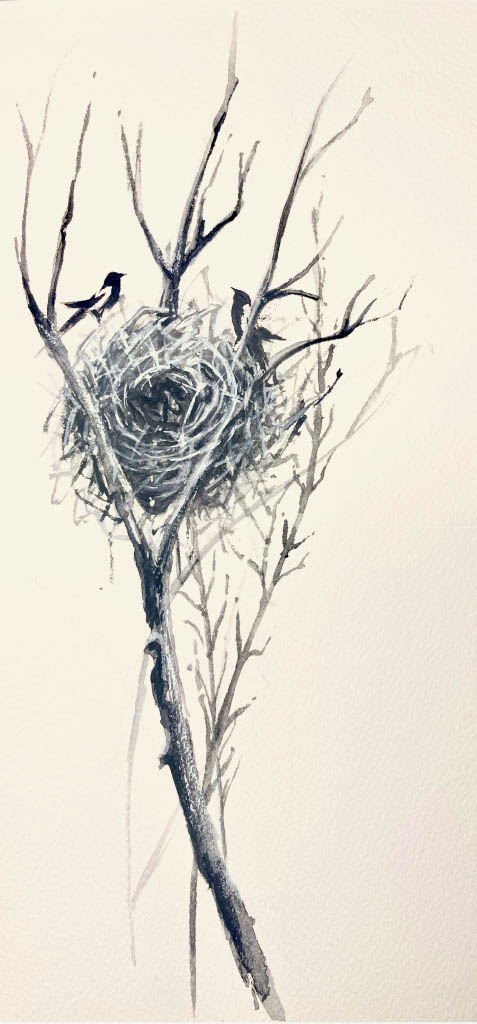
I directed my attention toward the sizable magpie nest perched on a bare tree branch in our front lawn, which had grown significantly since I arrived. My parents had eagerly pointed it out minutes after dropping off my suitcase: they gestured at the tree, explaining how, in Chinese tradition, a magpie’s nest outside one’s home symbolized good fortune. My dad had made a habit of sending videos via our family WeChat, capturing the delicate blue and white birds as they diligently assembled twigs and scraps. His excitement humored me.
At the time convinced myself I’d return to see the baby magpies hatch in the spring, but the truth was, I had no idea where I’d be by then. My entire life up to this point was neatly structured: whether it was getting into NYU or graduating, class schedules and midterms carried me from one semester to the next. I couldn’t begin to imagine how everything ahead would be wide open. The realization that month-long winter breaks would dwindle to a handful of vacation days sent a pang of sadness through me. I pushed aside the thought of being consumed by a sea of blazers and slicked-back buns pouring into the subways during rush hour and typing away at grey cubicles, all for some semblance of conditional gratitude. As I glanced around my bedroom at the posters and trinkets accumulated through my childhood gathering dust, I saw evidence of how the mundane could easily become a distant memory. I wondered whether this life would ever settle into a routine again, whether seeing my parents would ever feel ordinary rather than a cherished occasion to grasp onto.
In a couple of hours, I’d be holding back tears at the airport and promising my parents to return in no time, maybe even come back to China to live for a while; in a day or two I’d be alone in my East Village apartment on a Friday night, blocking out the sounds of drunk finance bros stumbling outside my window; within a week I’d be striding the streets and darting my eyes away from every passerby, engulfed by the monotony of school and the job search. The promise of return would grow less and less convincing. Was it too much to ask that things stay still for just a second?
Maybe, in an alternate timeline, the magpie’s nest was nothing more than a collection of twigs and scraps, or a mere idea in the universe waiting to materialize.
Shana is a Senior studying Media Culture and Communication and minoring in Studio Art. This is her final semester as a writer and editor for Generasian, and she’s extremely thankful for all of the amazing contributors to this magazine throughout the years, and for the welcoming community this club has offered her throughout her NYU journey ❤
 Generasian
0 comments on “喜鹊 Bird of Happiness”